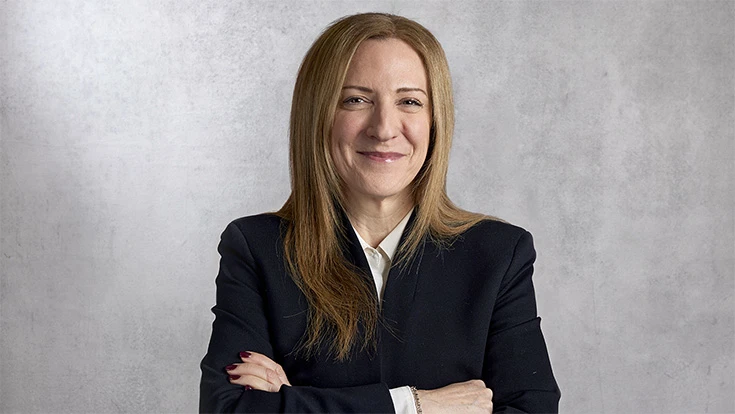
As everyone.connected reaches its four million target, Chief Corporate Affairs and Sustainability Officer at VodafoneThree, Nicki Lyons, reflects on some of her most memorable moments from the programme.
This month, our digital inclusion programme everyone.connected reached its final milestone of helping four million people and businesses cross the digital divide.
This is a huge achievement, and a huge number. So huge, in fact, that it’s difficult to actually put in perspective.
Which is why, over the years, my team and I have tried our best to share the individual stories behind these statistics. Stories that have constantly reminded us of why everyone.connected is such an important initiative.
So, to mark this amazing landmark, I’d like to share four of my own-first hand experiences of everyone.connected – one for every million people we have helped.
More of which you can read about in our new everyone.connected report.
1. Delivering the essentials with Trussell
It’s difficult to boil down four years of work to a few individual experiences, but one that still stands out is the time myself, Business Director Nick Gliddon and then-CEO of Vodafone UK, Ahmed Essam, swapped our usual Southbank office for a day volunteering at Greenwich Foodbank.
Kitted out in our branded Vodafone polos, we tried our best to keep operations running smoothly, which is certainly not an easy task at a site that distributes roughly 166,000 kilograms of food each year.
At the time, the Trussell community of food banks had provided more than 2.1 million food parcels for people in financial hardship between 1 April 2021 and 31 March 2022.
Despite the charity’s tireless work, this figure stood at 2.9 million in the 12 months up to March 2025. That’s equivalent to one parcel delivered every 11 seconds.
My own day volunteering, alongside subsequent stints since, has really helped to put these statistics into context. I clearly remember, for instance, Greenwich Foodbank’s project manager telling us that they were down to just four months’ worth of food in the centre at the time.
It’s hearing comments like this that really make you want to be part of the solution. And, as a result, volunteering at a food bank is something I have always recommended to my colleagues.
Thankfully, I’m pleased to say that hundreds have taken up the challenge over the years, while more than 250,000 free SIM cards have been distributed through food banks in the Trussell community and the Help through Hardship Helpline, which is jointly run by Trussell and Citizens Advice.
2. Bridging the connectivity gap with Good Things Foundation
While Trussell has been one longstanding partner throughout our everyone.connected journey, another has been Good Things Foundation, the UK’s leading digital inclusion charity.
In fact, we first started working with Good Things – then known as Tinder Foundation – back in 2014, a long time before I had even joined Vodafone UK.
Though plenty has changed in this space since, one constant has been the presence of Founder and CEO of Good Things, Helen Milner.
As Helen sets her sights on a well-earned retirement, it’d be remiss of me to overlook the impact she and the organisation has had on helping to close the UK’s digital divide.
A standout moment for me personally was when we convinced Helen to run around central London with us – on one of the hottest days of the year, no less – as we helped bring the issue of the ‘connectivity gap’ to life, courtesy of a five-metre-long piece of 3D artwork.
We were highlighting that, at the time, five million people were currently missing out on 5G in the UK, which threatened to widen the existing digital divide between rural or deprived communities and the rest of the country.
Sunburn aside, our work with Good Things over the years has been a huge success. Most notably, we recently met our target of providing 24 million gigabytes of data – enough to connect 200,000 people – through the organisation’s National Databank.
3. Depicting the realities of disconnection with Rankin
Back in 2022, we teamed up with another British powerhouse: world-renowned photographer, Rankin.
Though he has photographed everyone from David Bowie to the Queen, I’d argue that the work he did with Vodafone was some of his most important.
Having identified the ‘invisible issue’ of digital disconnection facing millions in the UK, Rankin helped us depict the true impact of living in digital exclusion.
He captured several individuals in situations based on real-life stories of the digital divide, with the images then made freely available on a popular stock image site.
The hope was that they would help represent a more accurate portrayal of the issue at hand, given that our research had found almost 80% of existing images online used only graphs, data or cartoons to illustrate digital exclusion.
We launched the ‘Faces of Disconnection’ series in line with everyone.connected reaching the one million milestone and, fittingly, this is also when we pledged to help a total of four million people and businesses cross the digital divide by 2025.
Looking back, it’s amazing to see how far we’ve come. Although, over the years, I’ve never doubted the fact that we would reach each of these milestones.
After all, from Vodafone colleagues to charity partners (and famous photographers), the people working to make this a reality are some of the most passionate and talented that I’ve ever had the pleasure of working with.
4. Affecting legislation with DSIT
Last, but certainly not least, it’s worth highlighting the impact that everyone.connected has been able to have on government legislation.
This is typified by our work with the Department for Science, Innovation and Technology (DSIT), alongside Deloitte and Good Things Foundation, to create a common set of principles for responsible device donation.
The IT Reuse for Good charter launched in June 2025, forming part of the Government’s Digital Inclusion Action Plan, and tying together our principles around both digital inclusion and sustainability.
Because, as well as supporting the reduction of electronic waste and circularity, the charter is also helping to increase the number of devices that can be donated to the digitally excluded.
Related to this – and on a more personal note – I was thrilled to join the Industry Leadership and Partnership subcommittee of the Government’s wider Digital Inclusion Action Committee.
Alongside colleagues from across the industry, our job is to assist the Government in reducing digital exclusion across every part of the UK, and it’s been an honour to be part of such a driven and influential group.
How is VodafoneThree continuing to tackle the digital divide?
As we celebrate the end of everyone.connected in its current guise, that doesn’t mean our work to tackle digital exclusion is over – far from it, in fact.
Because, despite all the progress made, around 3.7 million families still sit below the minimum standard for digital living, 1.6 million adults remain without a smartphone, tablet or laptop, and 8.5 million lack basic digital skills in the UK.
This makes initiatives like everyone.connected just as important today as they were when we first launched the programme back in 2021. Perhaps even more so, given that our latest research shows 61% of Brits believe being online is not only necessary, but a human right.
Which is why VodafoneThree will continue to focus on bridging the digital divide for years to come.
For now, however, I’d welcome you to join us in celebrating the impact that my Vodafone colleagues and our charity partners have helped achieve, by reading our everyone.connected four million report.
| Key facts and statistics about everyone.connected |
|---|
| Vodafone UK’s everyone.connected initiative has helped four million people and businesses cross the digital divide. This consists of: 1.76m donations of connectivity and tech; 0.15m affordable and accessible services; and 2.27m instances of upskilling businesses and communities. |
| everyone.connected has delivered £270m of social value across the UK, as calculated from: the total value of Vodafone SIMs donated via the charities.connected programme; the SIMs and devices donated through the Great British Tech Appeal; the savings to customers via social tariffs; and the SMEs supported via the business.connected programme and V-Hub platform. |
| More than 250,000 free SIM cards have been distributed through food banks in the Trussell community and the Help through Hardship Helpline, which is jointly run by Trussell and Citizens Advice. |
| Vodafone UK has provided 24 million GB of data through Good Things Foundation’s National Databank; that’s enough data to connect 200,000 people. |
| According to Good Things Foundation: 3.7 million families still sit below the minimum standard for digital living; 1.6 million adults remain without a smartphone, tablet or laptop; and 8.5 million lack basic digital skills in the UK. |
| As per Vodafone’s latest research, nearly four in 10 (39%) Brits believe digital communication skills are as important to getting ahead as social skills and basic literacy (36%), with 61% believing that being online should be a human right. |