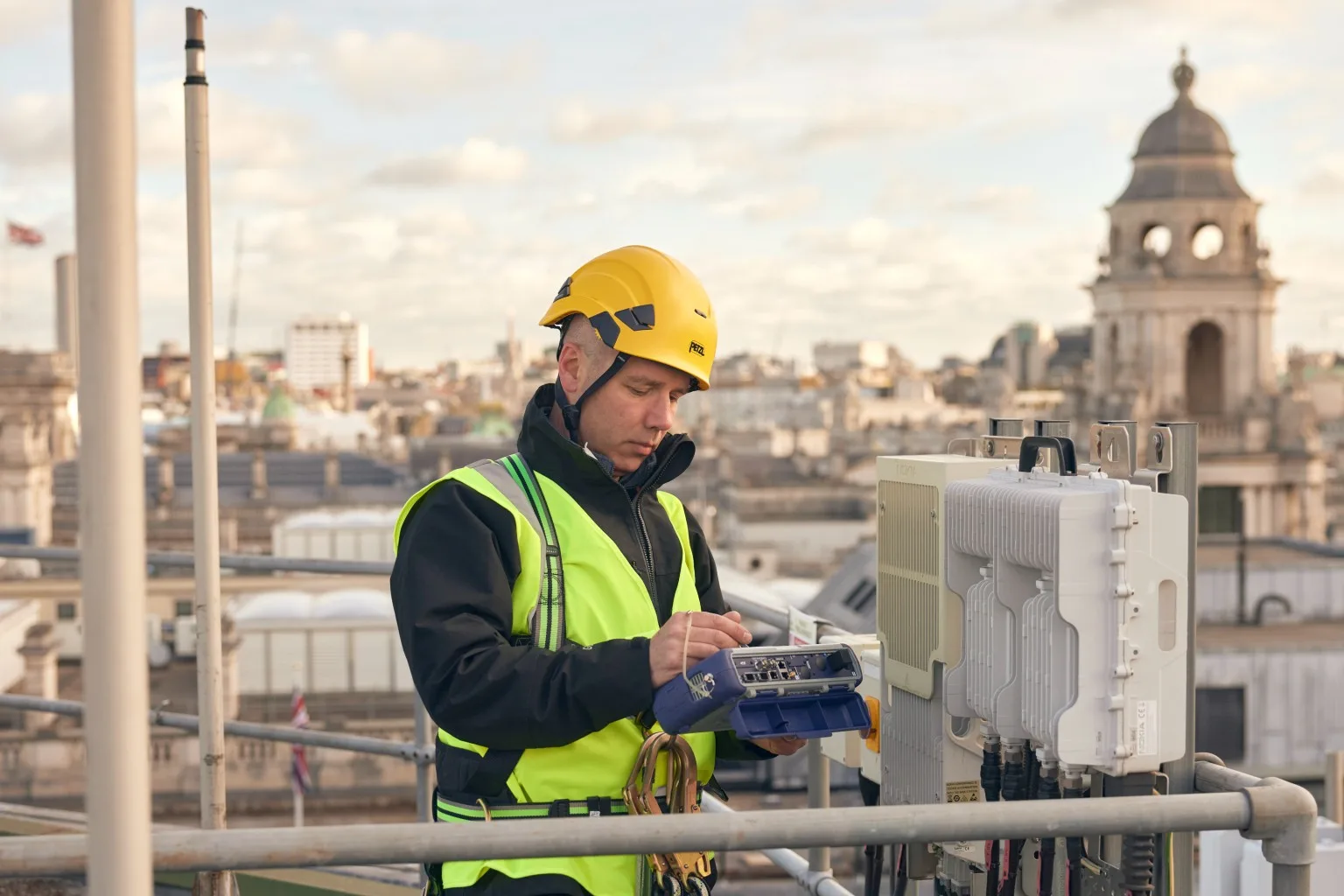
Andrea Donà, Chief Network Officer at VodafoneThree, argues that modernising London’s planning system is essential to protect mobile connectivity during redevelopment, supporting economic growth, investment and the capital’s digital future.
London is one of the world’s great global cities. But its mobile connectivity has not always matched that status. Research published by independent benchmarking company MedUX in 2025 ranked London last among 15 major European cities for overall 5G experience.
A key reason for this is that outdated planning policy and barriers to site upgrades have made it harder to deliver the digital infrastructure that the city needs. In a recent report published by VodafoneThree1, we found that these barriers are slowing network upgrades across London and, in turn, risk holding back investment, productivity and growth.
Through our £11 billion network investment to build the UK’s best network, we’re delivering fast, reliable 5G Standalone, otherwise known as 5G+, connectivity across the capital. Better connectivity will help future-proof London’s homes, businesses, high streets and transport hubs, providing the digital foundations needed for new housing developments, urban regeneration and long-term economic growth.
But if London is to remain competitive, unlock billions in economic value, and support new homes and communities, then planning reform must also keep pace with the city’s digital ambitions.
London needs to build. But it must stay connected while it does.
Redevelopment should not mean disconnection
Too often, the planning system risks pitting these priorities against each other unnecessarily.
In a city where space is limited, the same rooftops and buildings that are being redeveloped often host essential mobile infrastructure. When those sites are removed, the mobile coverage and capacity in the surrounding area is impacted.
This is happening through Notices to Quit, or NTQs: legal notices used by landowners to require telecoms operators to remove equipment from sites such as rooftops when a building is being renovated, redeveloped or demolished.
Redevelopment itself is not the problem. The problem is what happens when mobile infrastructure serving local communities is taken down before a replacement site is ready.
Nearly 100 of our sites in London are either already offline or are expected to come offline by the end of 2026 following an NTQ to enable redevelopment. Because of the complexity and length of London’s planning system, however, many of these sites will not be replaced for years.
Mobile networks cannot simply be moved overnight. A replacement site has to be technically suitable, available, acceptable to the site owner, viable under planning rules and capable of being connected into the wider network. In dense urban areas, that process can take around five years on average, and sometimes longer.
This creates significant risk to the connectivity that residents, businesses and local communities rely on every day, with buildings often redeveloped long before replacement mobile infrastructure is in place.
Local gaps Londoners can feel
London remains one of the world’s great connected cities but NTQs can create specific local problems: streets, homes, schools, businesses and transport routes where signal becomes weaker due to the removal of a particular site.
Our research shows what that can mean in practice. As a result of functional not-spots2, in the last 12 months: around 2 million adults were unable to use maps or navigation properly; 1.7 million were unable to check transport information; and 1.3 million were unable to contact someone when they needed to.
unable to use maps or navigation properly
unable to check transport information
unable to contact someone when they needed to
We’ve seen this impact first hand. A recent NTQ near King’s Cross resulted in hundreds of dropped calls every day until we could replace the site six months later. While we were ultimately able to restore lost coverage, this was only possible because we secured a cooperative replacement site provider and were able to progress the deployment relatively quickly.
These are not minor inconveniences. Reliable connectivity can be the difference between finding the right platform, reaching a loved one, completing a card payment, joining an important work call or navigating an unfamiliar part of the city.
It is also an economic issue. NTQs could be costing London’s economy at least £2.7 billion a year in lost output. That’s more than £7.4 million every day.
Smarter planning can fix this
Londoners should not have to choose between new homes and reliable mobile signal. New developments should strengthen the capital’s infrastructure, not inadvertently weaken it.
The good news is that this is fixable, and the Government is taking the issue seriously.
Our network upgrades across London will deliver better connectivity with fewer masts, provided we can get relevant planning permission to upgrade existing sites.
Achieving this requires a more joined-up approach across the planning system. We welcome the draft London Plan’s recognition of NTQs as an issue and its acknowledgement that maintaining mobile connectivity should be a priority during redevelopment and construction.
However, mobile connectivity needs to be more consistently embedded throughout London’s spatial strategy. The Greater London Authority should provide stronger recognition of the risk posed by NTQs and take a more active coordinating role where redevelopment threatens existing connectivity. This includes helping boroughs, developers, landowners and operators identify replacement options earlier, before coverage is impacted.
Boroughs can also support by giving earlier visibility of developments that may affect mobile infrastructure and working proactively with operators to maintain service continuity. At a national level, Government could further strengthen planning protections for existing mobile connectivity by extending the allowance for temporary sites to 36 months, providing more time to secure suitable permanent sites.
London’s strength has always rested on its ability to connect people — to jobs, ideas, markets, culture, transport and each other. In the 21st century, that connectivity is digital as well as physical.
London can keep building the homes it needs. It can keep renewing its high streets, workplaces and public services. And it can continue to stay connected throughout.
1 ‘Lost Sites, Lost Signal: The Impact of Notices to Quit on Londoners‘.
2 Functional Not-spot: An area where a mobile phone appears to have signal, but the network has become so
congested or degraded that it cannot meet local demand. As a result, mobile data services do not work reliably in practice.