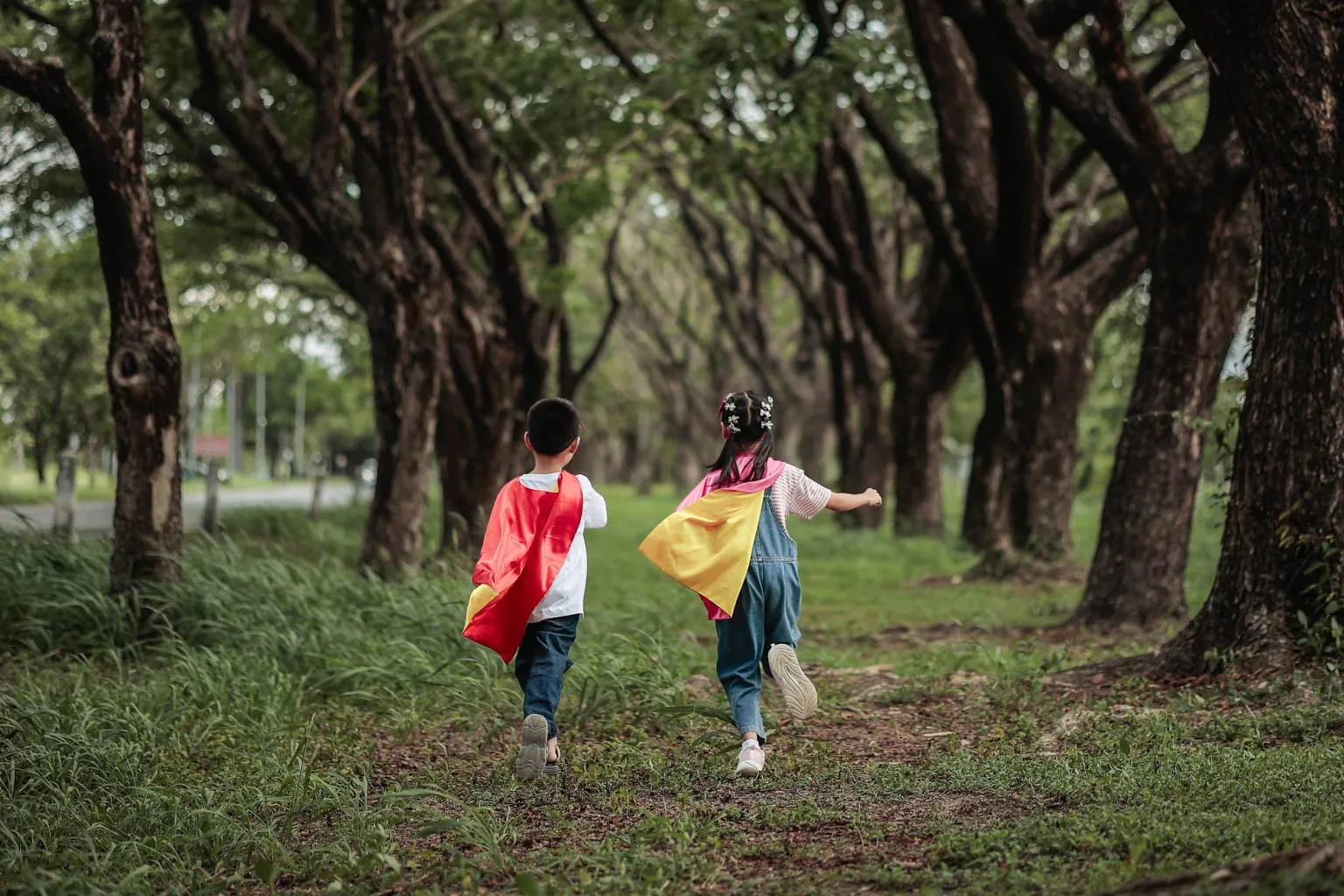
Think back to your favourite childhood memories. For many people, it’s likely that the majority will have taken place outdoors or in some sort of natural space – a beach, a forest, a wood.
The data seems to back this up, with a recent survey commissioned by The Wildlife Trusts finding that 88% of people have positive memories of spending time outside as a child.
“These become quite core memories for us of what childhood feels like,” says Helen Dodd, Professor of Child Psychologist. “But it’s something that the current generation are having less and less opportunity to do.”
Vodafone’s latest campaign with National Parks is focused on encouraging families to swap screen time for green time, and inspire outdoor play for people of all ages.
“We’re looking to recreate those playful experiences outdoors and in nature, even if they look and feel a little different today,” says Dodd.
“Screens and technology are part of our lives now, so what we need to think about is how we provide that outdoor play experience to meet children’s needs.”
How digital tools can improve access to nature
The solution may lie, partly, in a better understanding of how digital tools can be used to facilitate and enhance time in nature, rather than replace it.
“Being in nature is good for lots of aspects of children’s wellbeing,” explains Dodd, “so we want as many children as possible to be able to access it.
“While some will have grown up spending time in nature, and will be very confident about being in nature, many won’t have had that experience.”
This is somewhere where tech might help rather than hinder outdoor family time, whether it’s for locating nearby green spaces, finding suitable walking routes or even identifying wildlife once out and about.
“Connectivity can help remove some barriers to access,” continues Dodd, “which should make it easier for more people to access those natural spaces.”
Once children have access to nature, their imagination can really be let loose, with 30% of parents stating that objects like sticks, feathers and stones take a central role in their child’s imaginative outdoor games.1
Turning outdoor adventures into child’s play
To encourage these activities further, Vodafone and National Parks created the ‘Stick-tionary’ – a hand-illustrated guide to enjoying nature’s original smart device: the humble stick.
Filled with ideas to inspire adventure, the ‘Stick-tionary’ forms part of ‘The Stick’ campaign, which highlights how connectivity can support families to get out into nature and support their children’s outdoor play.
This is a topic Dodd is extremely familiar with, having recently been named Director of the new Outdoor Play Research .
The launch of the centre coincided with research from the University of Exeter, led by Dodd and colleagues, suggesting that children today are more than a year older when they start playing outdoors without supervision, compared to their parents’ generation.
Ideally, technology is used in a way that brings something additional, rather than acting as a barrier or detracting from the way that children naturally interact with the world and one another.
“What we want is for technology to be supporting children’s development, play and relationships in a positive way,” says Dodd.
“Screen time in itself is not the most helpful term, because that’s everything that we ever do in front of a screen. What’s more important is what children are doing when they’re on screens.”
“Ideally, technology is used in a way that brings something additional, rather than acting as a barrier or detracting from the way that children naturally interact with the world and one another.”
A passive, sedentary activity like scrolling on a smart device would fall under this latter category, but families can also use technology to learn about and access nature.
Can tech help children build a connection with nature?
Dodd points to the example of using a phone to identify bird sounds or plants as a good demonstration of the benefits that connectivity can have when used productively.
“Yes, technology offers children learning opportunities,” she explains. “This knowledge can help build a connection and understanding of nature, which might help children grow up to be ambassadors for the environment.”
With the natural environment more in need of protection than ever before – and technology able to encourage children to better understand the natural world – is it time to revisit how we view the relationship between tech and nature?
Dodd thinks so: “At the moment, it feels like we’re looking at everything through quite a negative lens. Screen time may dominate [the conversation] but, from my perspective, there are much broader issues at play.”
“We criticise children for being on screens too much, but we also criticise them if they’re outdoors and being too noisy, or we criticise parents if they let children out unsupervised.”
“What I would love to see is a shift towards us celebrating children being outdoors, being independent and being in public and natural spaces.”
Find out more about Vodafone and National Parks’ ‘The Stick’ campaign, and stay up to date with the latest news from VodafoneThree by following us on LinkedIn and Instagram.
1 Research conducted by Censuswide, among a sample of 2,002 parents aged 19+ with kids aged 4-16 AND their children. The data was collected between 24.06.2026 – 30.06.2026. Censuswide is a member of the Market Research Society (MRS) and the British Polling Council (BPC), and a signatory of the Global Data Quality Pledge. We adhere to the MRS Code of Conduct and ESOMAR principles.